From innovative ideas to investable opportunities: strengthening proof-of-concept funding
We are excited to welcome ‘Deepening university-investor links’, an independent review by Tony Hickson commissioned by Research England, on behalf of UKRI.
At the launch yesterday (3 February), we were reassured by its recommendation that more early-stage proof-of-concept (PoC) funding is vital for securing a strong pipeline of university spinouts to address the most pressing societal challenges and fuel UK economic growth.
Following the 2023 Independent Spinout Review commissioned by the previous government and authored by Irene Tracey and Andrew Williamson, TenU has strongly supported its call for more PoC funding and has mobilised the sector to produce guidance on how to optimise this type of funding for the benefit of UK Plc.
Hickson’s Review captures the UK research and innovation ecosystem at a point of clear and sustained strength. International rankings consistently place the UK among global leaders, and the report’s data shows how quickly this position has been converted into commercial outcomes — with growth in company formation, rising investment, and progress against key societal challenges. The opportunity now is to build on this momentum systematically and at scale.
Turning strength into momentum
PoC funding supports the critical early work that helps transform research into investable opportunities. Without this support, momentum can be lost where it matters most. This is especially key because the underlying pipeline is strong: UK universities are generating a growing number of high-quality opportunities across strategic sectors and addressing long-term societal challenges.
The Review highlights that funding challenges are shaped by the diversity of the UK’s innovation landscape, making it essential to understand the different contexts in which universities, technologies, and investors operate. Universities vary in scale and focus, technologies develop at different speeds, and investors engage at different stages – stakeholder needs are varied. Effective PoC funding must recognise these variations and provide flexible, well-signposted pathways that align with the innovation journey.
TenU’s role: building capability across the system
The review’s attention to PoC funding closely reflects TenU’s own work following the 2023 Independent Spin-out Review, through which we have supported the sector’s call for stronger provision and worked with universities and private and third sector partners to develop practical guidance on effective PoC design and delivery.
Our experience shows that PoC funding works best when it is treated as a core part of the innovation system. The Hickson Review reinforces this direction of travel. Rather than proposing a single solution, it points to the importance of coherent system design: PoC funding that is sufficiently resourced, sustained over time, and embedded within institutional strategies, while remaining adaptable to local strengths and different investor needs.
Keeping the whole investment journey in view
Recent initiatives to mobilise more patient capital at later stages – including the Mansion House Accord – are an important and welcome signal of ambition. Strengthening scale-up finance will be critical if the UK is to retain and grow the value created by its most successful companies.
However, later-stage investment depends on a strong flow of well-prepared opportunities upstream. Many of the technologies with the greatest potential for long-term societal impact, from life sciences to quantum and fusion, originate in universities. They require early support to be fully realised. Without robust PoC funding early enough in the journey, the UK risks losing out on vital innovations that could deliver both economic growth and meaningful societal benefit (see Figure 1).
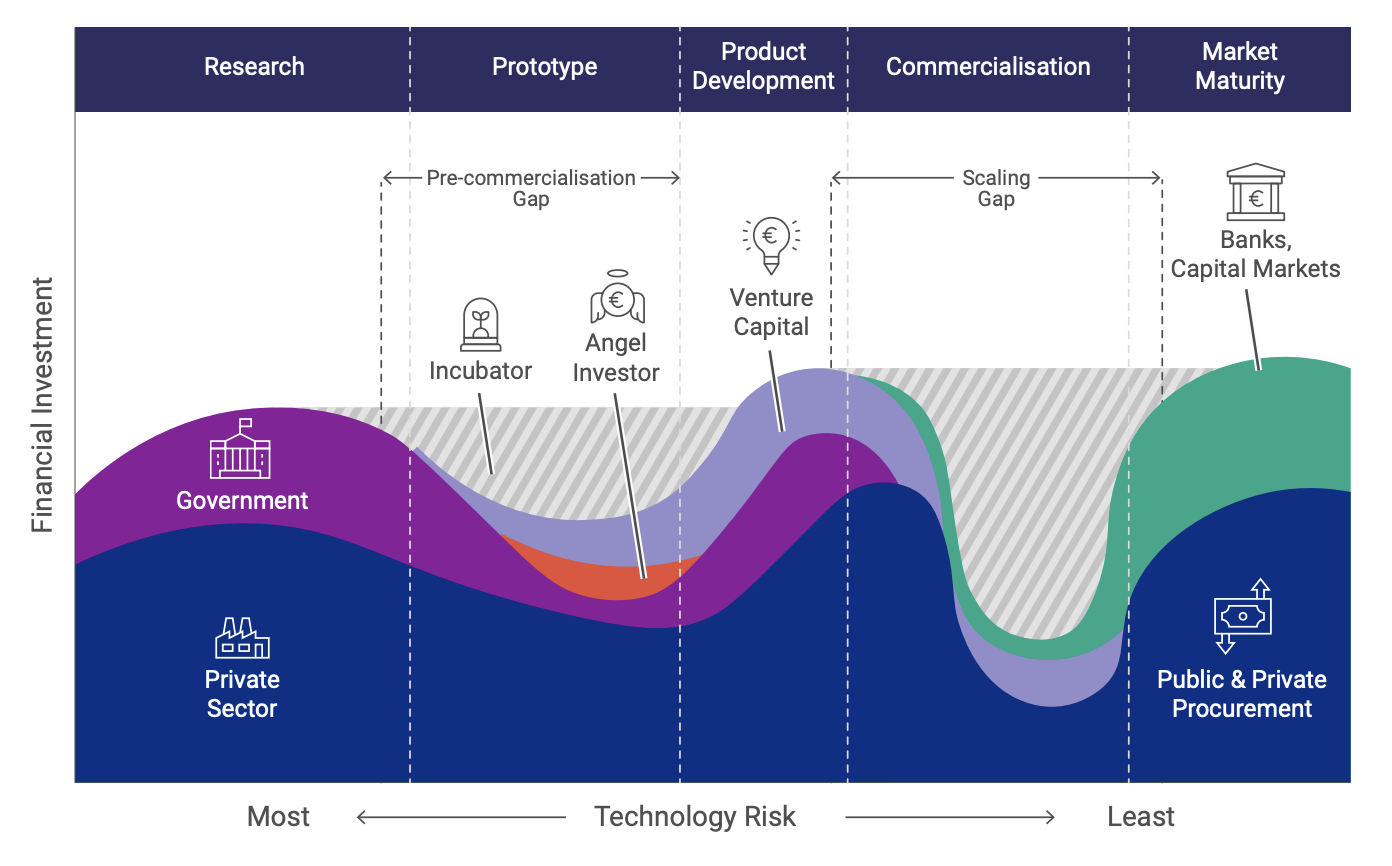
Figure 1: Simplified illustration of the start-up double valley of death
Source: Deepening university-investor links: a review by Tony Hickson – UKRI, p. 16.
Looking ahead
TenU celebrates ‘Deepening university-investor’ links as a positive and timely contribution to the ongoing conversation about how the UK strengthens its innovation ecosystem. The review sets out an ambitious, system-wide vision for the future, recognising both the UK’s existing strengths and the opportunity to move further, faster.
Building on this momentum, TenU will continue its evidence-led work on PoC funding, including guidance to be published in June 2026 on effective, scalable PoC funding models, drawing on international experience and the collective insight of our members.
Together, these efforts can help ensure that the UK not only generates world-class ideas, but also consistently converts them into impact – supporting growth, competitiveness, and solutions to humanity’s challenges.